
Cost of Orthodontic Treatment
Coverage in the Public Health Insurance
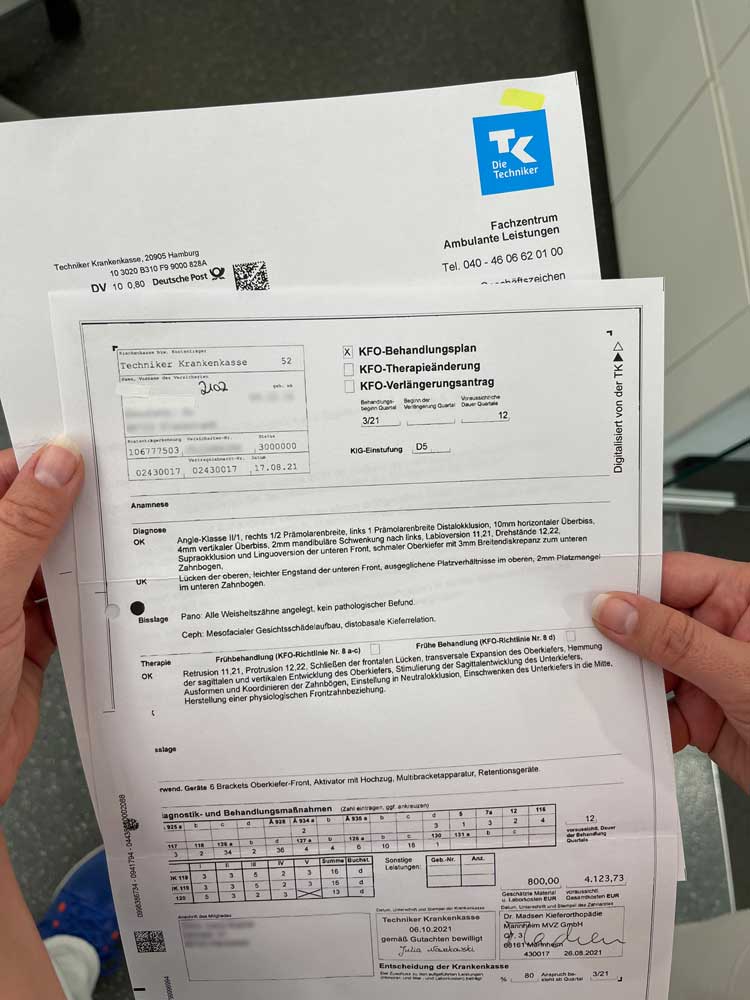
Until the age of 18, orthodontic treatment is covered by statutory health insurance (GKV) depending on the severity of the findings. The findings are classified according to orthodontic indication groups (KIG). Of the 5 KIG grades, only grades 3, 4, and 5 are covered by insurance; for grades 1 and 2, orthodontic treatment must be paid for privately.
For example, statutory health insurance pays if two incisors deviate from each other by more than 3 mm, or if the overbite of the incisors is greater than 6 mm. The orthodontist is responsible for classification according to the KIG. The GKV’s obligation to pay for orthodontic treatment expires on the patient’s 18th birthday. There is only one exception to this rule: if the treatment of adults includes complete surgical relocation of a jaw, the costs are also covered after the patient’s 18th birthday. Apart from this exception, orthodontic treatment is generally no longer covered by statutory health insurance after the patient’s 18th birthday. Furthermore, there are no hardship cases or partial reimbursements.
If you are eligible for benefits, you have a legal right to orthodontic treatment without additional payments. However, statutory health insurance only pays for simple standard services that are described as “appropriate, economical, sufficient,” and “not exceeding what is necessary.” This is often difficult, as even the diagnostics, for example, are not covered by health insurance, neither the 8 diagnostic photos that are standard practice worldwide nor the functional diagnostics required by all professional associations.
Many innovations, such as the use of temporary mini-implants for anchoring, non-compliance appliances, or removable, transparent aligners, are not available under statutory health insurance. And even with fixed braces, which are generally covered by insurance, there are increasing problems with the reimbursement of necessary repairs and the number of wires that can be used.
Another problem is that removable appliances generate significantly higher profits for statutory health insurance providers than the much more effective fixed braces, meaning that purely fixed treatments are not very economical for doctors within the statutory health insurance system. Fees have been repeatedly reduced over many years in statutory health insurance, which has inevitably had an impact on the quality of treatment.
So if a particularly short, comfortable treatment or a top result is desired, such wishes can be fulfilled with the help of private co-payments.
Additional Payments
Against this backdrop, since 2001 almost all orthodontists have been charging privately insured patients additional costs ranging from a few hundred euros to over €3,000. Unfortunately, it is almost impossible for patients to understand the relationship between the prices charged and the services provided. This has created an opaque market for additional services. There are certainly orthodontic practices that charge additional private costs for allegedly high-quality treatment, but then plague young patients with years of ongoing treatment with barely functional removable braces.
At our orthodontic practice in Mannheim, we offer optimal orthodontic treatment for patients with statutory health insurance for an additional payment of €2,200. This means almost exclusively fixed appliances, very short treatment times, minimal hassle, and excellent results. The average treatment duration for adolescents is only 18 months – extremely short compared to the 3-4 years that is standard in Germany.
For an additional cost, we also offer a complete diagnosis, consisting of the necessary 8 photos (only 2 in statutory health insurance!) and a functional diagnosis, which scientific organizations such as the DGFDT, DGKFO, and DGZMK require before treatment, but which is not covered by statutory health insurance. The poor dentist has to live with this contradiction and put on a friendly face.
Without Additional Payment
Nevertheless, there is a legal right to orthodontic treatment without additional payment. If parents do not want to make this additional payment, we naturally offer orthodontic treatment without it, which then of course must strictly comply with the provisions of the public health insurance – “suitable, economical, sufficient”. This usually means that a larger proportion of the treatment is performed with removable appliances, and the duration of treatment is about 3-4 years as it is common in Germany.
Coverage in the Private Health Insurance

Until the year 2000, private health insurance (PHI) was a paradise. PKV offered its mostly young, healthy and well-off policyholders excellent comprehensive coverage for little money, while hardly any attention was paid to economic issues. Unfortunately, these times are gone.
Those days are long gone: today, private health insurers increasingly check whether treatment will be reimbursed at all and, above all, how much. With around 50 private health insurers in Germany offering countless different rates, there are significant differences in the reimbursement of treatment costs. Occasionally, generous reimbursements are still available. More often, however, we see numerous items being refused reimbursement, often in clear violation of the law.
In the case of adults, private health insurance companies always require diagnostic documents for assessment, whereas in the case of children this is only occasionally the case. The experts commissioned by private health insurance companies are, of course, not neutral, but are employed by or contracted to the private health insurance company and this is often reflected in the expert opinions.
More often than disputes over the necessity of treatment, conflicts arise in private health insurance over the amount of the bill, in particular the increase factors and their justifications. Reimbursement for individual services is also often refused on the pretext that they are not medically necessary or – a very popular argument – cannot be billed at all, meaning that the orthodontist may only provide the planned service free of charge.
These disputes are increasingly stressful for orthodontists and patients—but unfortunately they cannot be avoided! In order to find out the exact scope of reimbursement for orthodontic treatment, patients must always have a treatment plan drawn up by their orthodontist and submit it to their private health insurance company. Without a treatment plan, only general and non-binding information is provided.
In addition, the point value (i.e., the base price) of the fee schedule for dentists (GOZ), which is used for billing in the private health insurance sector, has not been increased since 1988, while wages and prices have roughly doubled during this period. This means that a uniform increase of 4.5 times would have to be applied today in order to reach even the base rate of 2.3 from 1988. Aggressive billing for treatments is therefore essential for practices to survive.
No adjustment of the GOZ point value in sight
There are still no plans to adjust the GOZ point value, as the state has a secret interest in the GOZ expiring due to the large number of privately insured civil servants. This makes it increasingly difficult to charge an appropriate fee for high-quality treatment.
For this reason, the increase factors must be set regularly at up to 3.5 times the rate, and often even higher. Due to these increases and the declining willingness of private health insurers to reimburse costs, privately insured patients must get used to the fact that they will have to bear a certain portion of the costs themselves.
The total treatment costs can range from €1,000 for straightening two front teeth to well over €10,000 for complex treatments for adult patients. A deductible of between 10-50% of the treatment costs is now to be expected on a regular basis.
Orthodontics Costs in the State Aid System
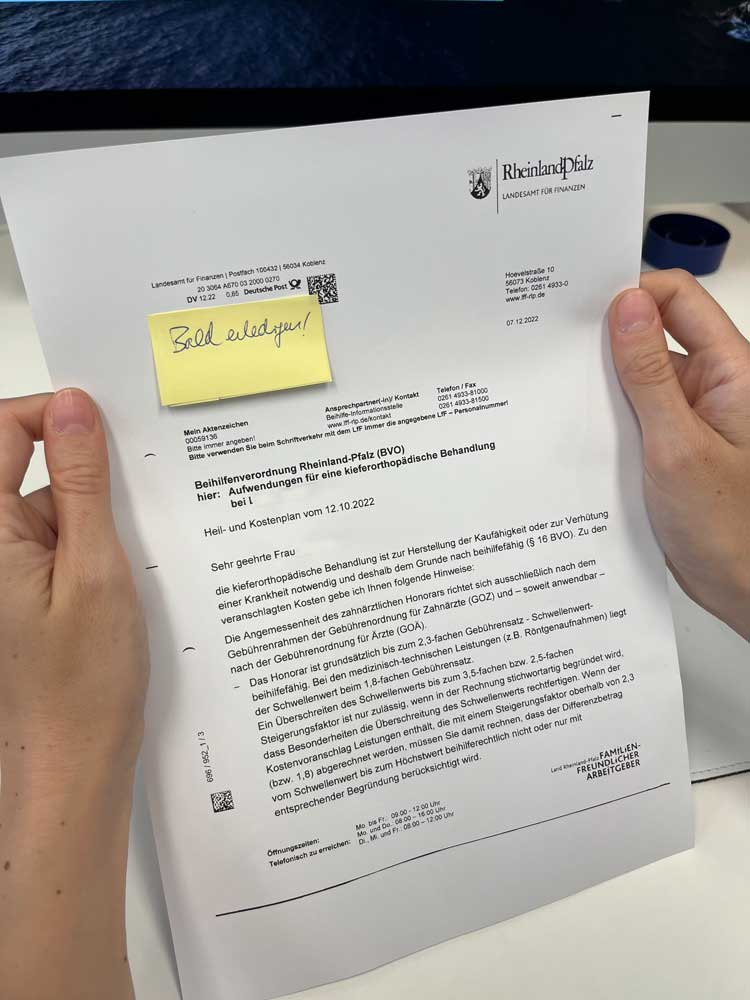
Most subsidies have aligned their reimbursement behavior with that of the statutory health insurance funds. Thus, the principle of the statutory health insurance that “expedient, economical, sufficient” applies to the aid area. Although patients eligible for subsidies are privately insured, they can only expect modest reimbursements for their subsidy portion.
Internal regulations, known as subsidy regulations, even exclude subsidies from reimbursing many services altogether. Of course, this does not mean that these services are not billable, because orthodontists bill according to the GOZ, while the various subsidy regulations are not available to them and have no legal significance for billing. For these reasons, a certain deductible is almost always to be expected for the subsidy portion.
Self-Payers - Without Insurance Coverage
If neither statutory nor private health insurance covers orthodontic treatment, as is increasingly the case, patients become self-payers. In these cases, the price of treatment can be freely agreed upon without regard to any cost bearers and their bureaucracy.
Since self-payers do not require correspondence with cost bearers and simplified billing for the orthodontist, self-payers are valued in our orthodontic practice in Mannheim and can expect a slightly lower price than would be usual for privately insured patients. In addition, we always offer self-payers interest-free installment payments.