After having completed the orthodontic treatment, the anterior teeth have a lifelong tendency to relapse into the old tooth position. To prevent relapse, permanent stabilization of the anterior teeth in particular is required after active treatment. Retention after treatment reasonably lasts a lifetime!
Fixed and removable retainers
Retainers are all braces that are used to stabilize the position of teeth after orthodontic treatment. There are fixed and removable retainers.
Fixed retainers are usually thin metal wires that are invisibly bonded to the inside of the front teeth and can remain there for life. The advantage is the reliable stabilization of the tooth position, the disadvantage is the difficulty of oral hygiene and occasional breakage of individual bonds.
Unfortunately, the braided steel wires most commonly used for fixed retainers have one annoying disadvantage: they can occasionally cause unwanted tooth movement. This problem no longer occurs when fixed retainers are 3D-milled, as is the case with the Prime4me retainer from Dentaurum. The Prime4me retainer is made of grade 5 titanium, an alloy that is also used for implants.


Removable appliances for retention
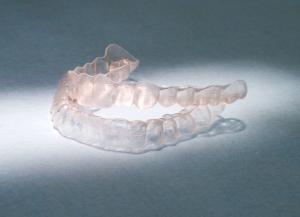
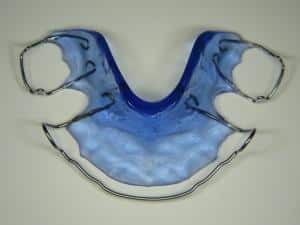
Plate appliances or thermoformed transparent plastic splints are used as removable retainers, occasionally positioners. In some cases, bimaxillary appliances of the activator type can also be used as retainers.
Removable retainers are slightly advantageous from the hygienic point of view, but they are also more unreliable, as they are often not worn sufficiently or can be lost at inopportune moments.
In cases where the front teeth were severely twisted before treatment, wearing the retainer at night alone is often not enough. The loose retainers would have to be worn during the day as well, at least initially—but that is unrealistic, as hardly any patients do this!
In addition, they wear out over the years and must be replaced periodically, if only for hygienic reasons – and this can be expensive for lifelong retention.
Advantages of the fixed retainers
Fixed retainers, on the other hand, can remain in the mouth for many years, so they are usually the better solution economically as well. Above all, the most important thing – keeping teeth straight for years – is achieved more reliably with fixed retainers.
Precise adjustment of retainers
Unfortunately, we often see clumsy, uncomfortable fixed retainers that are often stuck halfway over the gum line and make good dental hygiene impossible. For this reason, we have the fixed retainers 3D milled after scanning.
These retainers fit the inner surfaces of the front teeth with previously unattainable precision, regardless of how jagged their shape is. In some cases, especially when time is of the essence, we also have retainers prefabricated in the dental laboratory after impressions have been taken.
The retainers, which are neatly fitted to the inner surfaces of the teeth, are precisely positioned in the mouth with a silicone setting aid.